
Learn
NOI: net operating income explained
Net operating income is the number a commercial building is valued on. Here is how to calculate it and the mistakes people make.
Updated October 6, 2026
If the cap rate is the price of income, net operating income (NOI) is the income. Appraisers, lenders and buyers all start from it, and almost every way an owner adds value to a building comes down to raising it.
The formula
NOI = effective gross income − operating expenses
It is built up in three steps:
- Potential gross income: the rent if every space were leased at its current rent, plus other income such as parking, laundry, storage or signage.
- Effective gross income: potential income minus vacancy (empty space), credit loss (tenants who don't pay) and concessions (free months given to sign a lease).
- Net operating income: effective gross income minus the costs of operating the property.
NOI is normally stated per year. A building's value is its annual NOI divided by the market cap rate.
What counts as an operating expense
- Property taxes and insurance. Usually the two biggest fixed costs.
- Repairs and maintenance. Fixing leaks, servicing the HVAC, painting a vacant unit.
- Utilities the owner pays, such as common-area power, water and trash.
- Property management. Often a percentage of collected rent, plus on-site staff for larger buildings.
- Leasing and administration. Advertising vacancies, legal and accounting for the property.
- Contract services. Landscaping, cleaning, security, elevator contracts.
Who pays these depends on the lease. In a triple-net (NNN) lease, common for single-tenant retail and industrial, the tenant pays taxes, insurance and maintenance, so the owner's expenses are small. In a gross or full-service lease, common in offices and apartments, the owner pays and sets rent high enough to cover it. Two buildings with the same rent can have very different NOI because of this.
What does not count
- Loan payments (debt service). NOI describes the building, not how the owner financed it. Two owners of the same building with different loans have the same NOI.
- Capital expenditures. A new roof, parking lot or elevator lasts for years and is usually kept below the NOI line. Careful buyers subtract a yearly reserve for it anyway.
- Tenant improvements and leasing commissions. The cost of building out space for a new tenant and the broker's fee for finding them. Real money, but often shown separately.
- Depreciation. A tax deduction, not a cash cost.
- The owner's income taxes. They depend on the owner, not the building.
A worked example
A 24-unit apartment building, each unit renting for $1,500 a month:
| Line | Annual |
|---|---|
| Potential rent (24 × $1,500 × 12) | $432,000 |
| Other income (laundry, parking) | $12,000 |
| Less vacancy and credit loss (6%) | −$26,640 |
| Effective gross income | $417,360 |
| Property taxes | −$52,000 |
| Insurance | −$18,000 |
| Repairs and maintenance | −$30,000 |
| Utilities (common areas, water) | −$26,000 |
| Management (5% of collected income) | −$20,868 |
| Payroll, admin, contracts | −$29,000 |
| Net operating income | $241,492 |
Expenses come to about 42% of effective income here, a normal range for apartments where the owner pays some utilities. At a 6% cap rate this building is worth about $4.0 million.
NOI versus cash flow
NOI is what the building earns. Cash flow is what reaches the owner after the lender is paid and money is set aside for big repairs:
Cash flow before tax = NOI − debt service − capital reserves
Suppose the owner above borrowed $3,000,000 at 6% with 25-year amortization. The payments come to about $232,000 a year, and that, plus a $7,200 reserve, leaves only about $2,000 of cash flow. Healthy NOI, nearly break-even cash flow. Lenders check this with the debt service coverage ratio (DSCR = NOI ÷ annual debt service); this loan sits at 1.04, below the 1.20–1.25 many lenders want, so in practice the owner would be offered a smaller loan.
The return on the owner's own money is cash-on-cash return: annual pre-tax cash flow after debt service ÷ cash invested. It is not NOI ÷ down payment; that figure ignores the mortgage and overstates the return.
How owners raise NOI
Since value is NOI divided by the cap rate, a dollar of NOI is worth many dollars of value. At a 6% cap rate, each $1 of annual NOI is worth about $16.67. The levers:
- Fill vacancy. Usually the biggest lever in a building that isn't full.
- Bring rents to market as leases roll over, without driving good tenants away.
- Add income: parking, storage, signage, fees.
- Cut costs: rebid contracts, appeal property taxes, fix the leaks that drive the water bill.
- Pass costs through: move tenants to leases where they share taxes and maintenance.
Watch for the opposite trick in sales brochures: deferred maintenance or a skeleton management budget makes NOI look higher than a new owner will see.
How CRE Tycoon models NOI
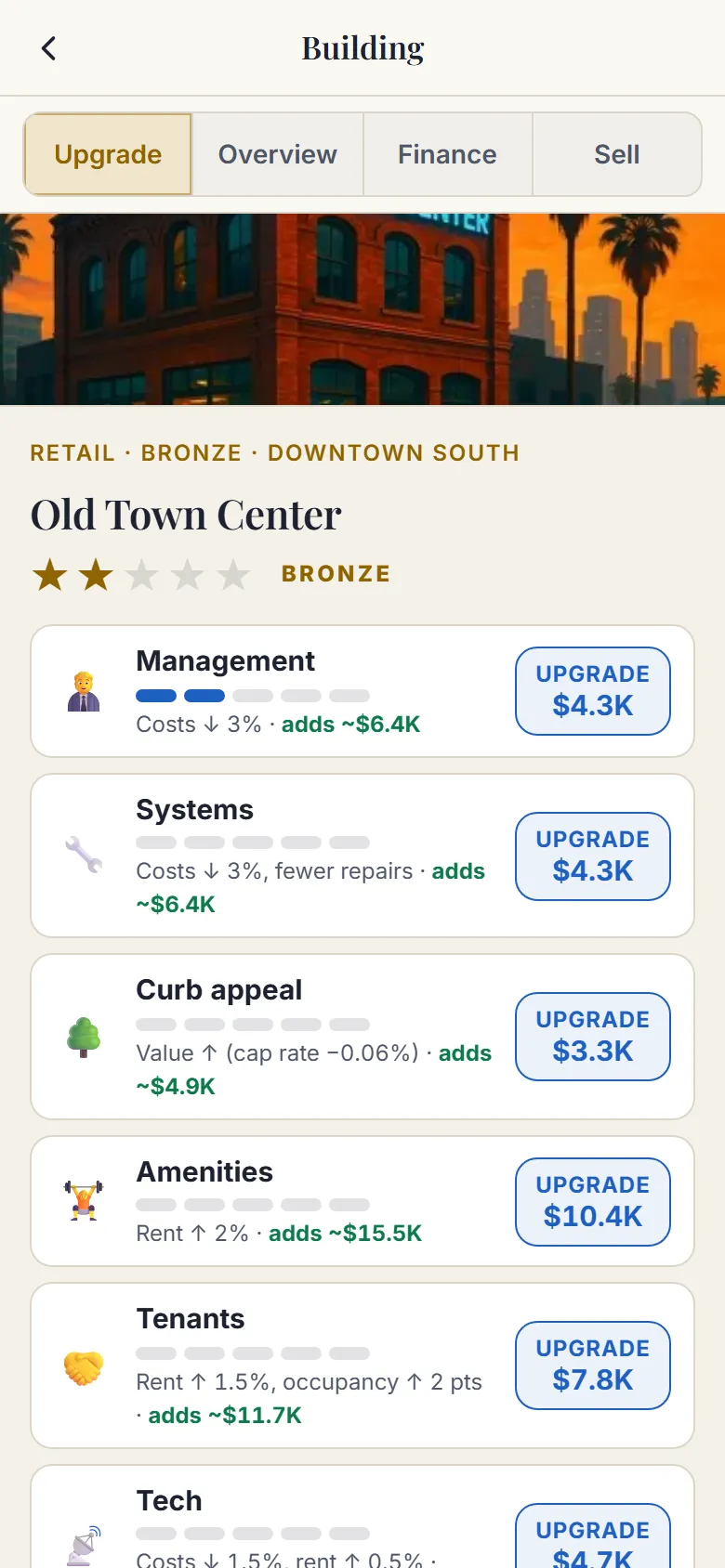
Each building you own runs on the same arithmetic: rent times occupancy, minus operating costs, gives NOI; your loan payment comes off after that to give the monthly cash flow you actually collect. Very empty buildings cost more to run per occupied unit, as they do in real life, and trouble such as a burst pipe or a tenant who stops paying can dent the income.
The levers are the real ones in simplified form. A business plan leases the building up. The 6 upgrade tracks each work on one side of the NOI line: Management (costs ↓ 3%), Systems (costs ↓ 3%, fewer repairs), Curb appeal (value ↑ (cap rate −0.06%)), Amenities (rent ↑ 2%), Tenants (rent ↑ 1.5%, occupancy ↑ 2 pts), Tech (costs ↓ 1.5%, rent ↑ 0.5%). Because the game values your buildings at NOI divided by a cap rate, each upgrade shows the value it adds next to its price, and you can watch the dollar-of-income, many-dollars-of-value rule play out.
The short version
- NOI = income actually collected − the costs of operating the building.
- Loan payments, capital projects, depreciation and income taxes are not operating expenses.
- Value = NOI ÷ cap rate, so raising NOI is how owners create value.
- Cash flow is what's left after the loan, and it can be thin even when NOI looks healthy.
Try it on a real career
Free in your browser, on your phone or desktop. No download, no account.