
Player guide
Buying and financing
Commissions are fast money. Buildings are where it compounds. Here's how an offer becomes a building you own.
The Market tab
Your first commission opens the Market. It lists the buildings for sale right now in the districts you've unlocked, with their price, occupancy and income. The list changes every month: new buildings come up, overpriced ones get price cuts, and rival brokers buy the bargains you leave sitting (see The market). You can browse every building in the game on theBuildings page.
Now and then a card also suggests the buildings you can afford, with an Offer button on each. Those offers go in at 90% of asking with 25% down.
The deal sheet
Tap a building to open its deal sheet. You set three things:
- The offer price. It opens at 90% of asking. You can go lower or pay up to win the building.
- The down payment. At least 25%, or pay all cash.
- The loan. The bank to start; hard money from Associate; a private lender from Senior Broker.
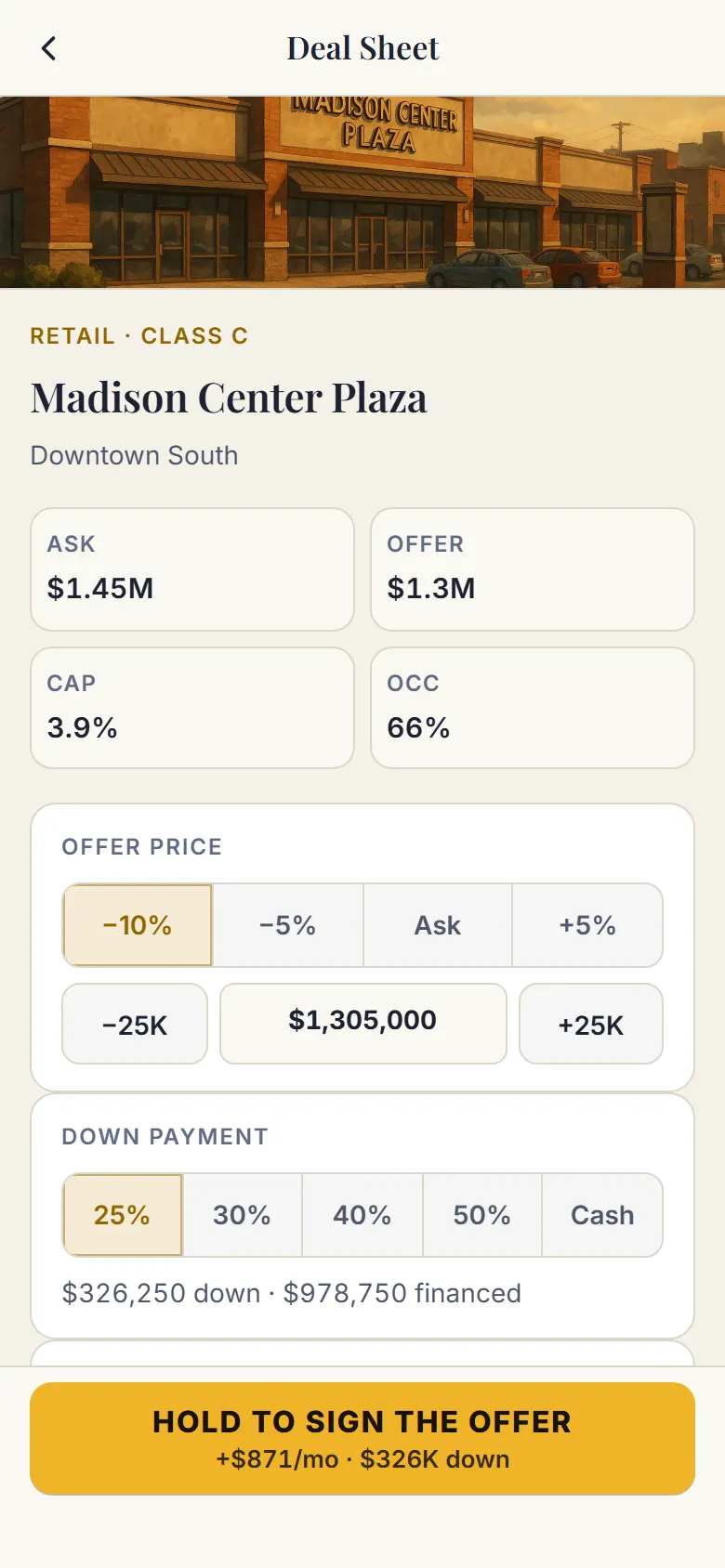
The sheet shows what the building pays you each month today and once it's leased up, after the loan payment. When the numbers work,Hold to sign the offer. An offer costs an action (two with a private lender).
Interest-only loans
Every loan covers up to 75% of the price and is interest-only: you pay interest each month, and the balance stays the same until you refinance or sell. Rates are priced off the market's benchmark rate, which moves with the cycle, so the same building can be cheaper to finance one year than the next.
The bank's coverage test
The bank checks the debt service coverage ratio, or DSCR: the building's yearly income divided by the yearly loan payments. It looks at the income the building will make once it's full, trims it by 10% to be safe, and wants a ratio of at least 1.0. In plain terms, the rent has to cover the loan. If it doesn't, the sheet tells you, and offers a mix of down payment and lender that would pass.
Hard money ignores the coverage test but costs a lot more in interest. It's for buildings that are mostly empty today and need a plan to fill up.
Accepted, countered or refused
A full-price offer is always accepted. Below asking, it depends on the seller: an emptier building, a weaker class, and a building that has sat on the market for a while all make a seller more willing to deal. Your negotiation skill helps too. A seller who turns you down will often counter somewhere between your offer and their price. You can Accept the counter or Walk away. Lowball hard and some sellers won't negotiate at all.
Closing at month end
An accepted offer is under contract, and your down payment is held. The purchase closes when you end the month. Before it does, the building is inspected. Most inspections are clean, and sometimes the seller even gives you a credit for small things. If the inspection finds a real problem, nothing closes until you decide:
- Ask for a credit and the seller may take the repair cost off the price,
- Close anyway and pay for the fix yourself after closing,
- or Walk away and lose a small earnest deposit.
Inspections find more problems in hot markets, and sellers give credits more readily in weak ones.
Pick a business plan
A new building's first real decision is how you'll run it. Without a plan it never fills past 80% and its value slides. A plan has three stages; you fund each one, it takes a few months, and it lifts occupancy and income. Each choice shows what it costs and the refinance cash-out you can expect when it's done.
| Plan | Opens at | For |
|---|---|---|
| Stabilize | Rookie | any building |
| Value-Add | Associate | any building |
| Reposition | Broker | retail and office buildings |
| Redevelop | Senior Broker | industrial and apartment buildings |
- Stabilize. Fix deferred maintenance, fill vacancies, get NOI stabilized. Safe and accessible.
- Value-Add. Improve the building beyond basics — better amenities, modern infrastructure, premium tenants.
- Reposition. Fundamentally change the property's market position — convert a tired Class C into a Class A asset.
- Redevelop. The nuclear option — essentially rebuild the property. Maximum risk, maximum reward.
Once it's full, the building is ready for the first windfall. Read Refinance and sell, and see Upgrades for the six tracks that push its value further.
Try it on a real career
Free in your browser, on your phone or desktop. No download, no account.